The Limousine
Intro
Most people have seen a tandem bicycle at some point and had the same thought: that looks complicated.
Two riders on one bike, one steering, one sitting behind, both pedaling at the same time. From the outside it looks slightly chaotic and perhaps a little fragile, like a mechanical experiment that somehow stayed upright.
In reality, tandem riding is far more structured than it appears. Every movement, every shift, and every start requires coordination. One rider steers, but both riders power the bike. You share cadence, decisions, and sometimes the occasional pothole.
Since Marco and I ride our tandem for long distances and will be participating in the Race Around the Netherlands 2026, we often get questions about how tandem riding actually works. Who does what? How do you start? How do you steer? And how do two people avoid constant chaos on one bicycle?
So here is a small explanation of how our tandem works, how we ride it, and why two people on one bike can sometimes make surprising sense.
What is a tandem bicycle and how does it work?
A tandem is a bicycle built for two (or more) riders. The drivetrains are linked, meaning both riders share the same cadence and, frankly, the same destiny 😅.
The person in front is called the captain. In our case, that is Marco. The captain is responsible for:
- Steering
- Braking
- Shifting
- Short term navigation (for example: “turn left in 50 meters”)
- All road decisions (can we squeeze in or should we wait?)
- Setting the pace
- Putting down the power that actually moves us forward
I sit at the back of the tandem, in what is called the stoker position. In our setup my job is to “stoke the engine” and provide power to move the tandem forward, but my responsibilities extend well beyond that.
- Route design: preparing all our routes beforehand
- Identifying POIs along the route: convenience stores and places that sell grab and run food. I also look up ATMs, train stations and hotels.
- Food logistics: making sure we do not run out of food or water between stops
- Food and hydration management: did I eat and drink enough? When was the last time Marco ate or drank?
- Hotel scouting: how far to the next three hotels? How do we reach them? Do they have a room available? Do they provide a safe place to park a 2.4 meter (8 foot) bicycle?
- Race and pace strategy: how are we holding up? Are we riding too slow or too fast?
- Navigation support: I also help with navigation in several ways.
- I look at the Garmin the same way I would on my solo bike and call out turns as early and clearly as possible:
“500, roundabout, second exit.” (meaning: In 500 meters we will enter a roundabout, take the second exit). There is often a lot happening on the road, and having a second pair of eyes on the navigation has saved us from a few nasty missed turns. - I help with short distance navigation, for example:“50, left.” (meaning, in 50 meters, turn to the left). This sounds easy, but please note that I cannot see forward at a 30 degree angle. That makes things surprisingly difficult, especially when two roads fork to the left and Marco asks which one to take. At that point I usually cannot see either of them and have to rely on my Garmin and a vague internal compass that says something like “this looks kind of north-ish.”
- When it’s dark or the road demands Marco’s full attention, like on fast descents or surprise patches of rough gravel, I guide the timing with a steady countdown: “left in 90, 80, 70, 60, 50, 40“. He responds with “see it” or “got it” the moment he has the turn.
- One of my key roles is checking behind us before turns. When Marco asks “car?“, I look over my shoulder and reply either “free, go” or “car“.
- If our communication on the bike sounds brief or even blunt, it’s intentional. For Marco, clear, concise calls like “500, roundabout, second exit” are faster and less ambiguous than full sentences. On a tandem, clear and unambiguous communication is essential. You’re riding one bike and trying to function as a single organism, which means everything has to be communicated openly and precisely. Of course we still chat like any two people on a ride, but for critical things like navigation, food, and stops, we rely on a shared set of clear, consistent keywords.
- I also handle long distance navigation: In 37 km we will enter a town with a grocery store, a bakery, and an ATM. Then the real questions start. Do we need food or water? How far off our route is the store? How do we get there? Does Marco want something specific? Do we have enough supplies to comfortably reach the next stop?
- I look at the Garmin the same way I would on my solo bike and call out turns as early and clearly as possible:
- And occasionally, I try to take pictures. I am still terrible at it.
Which tandem do we have?
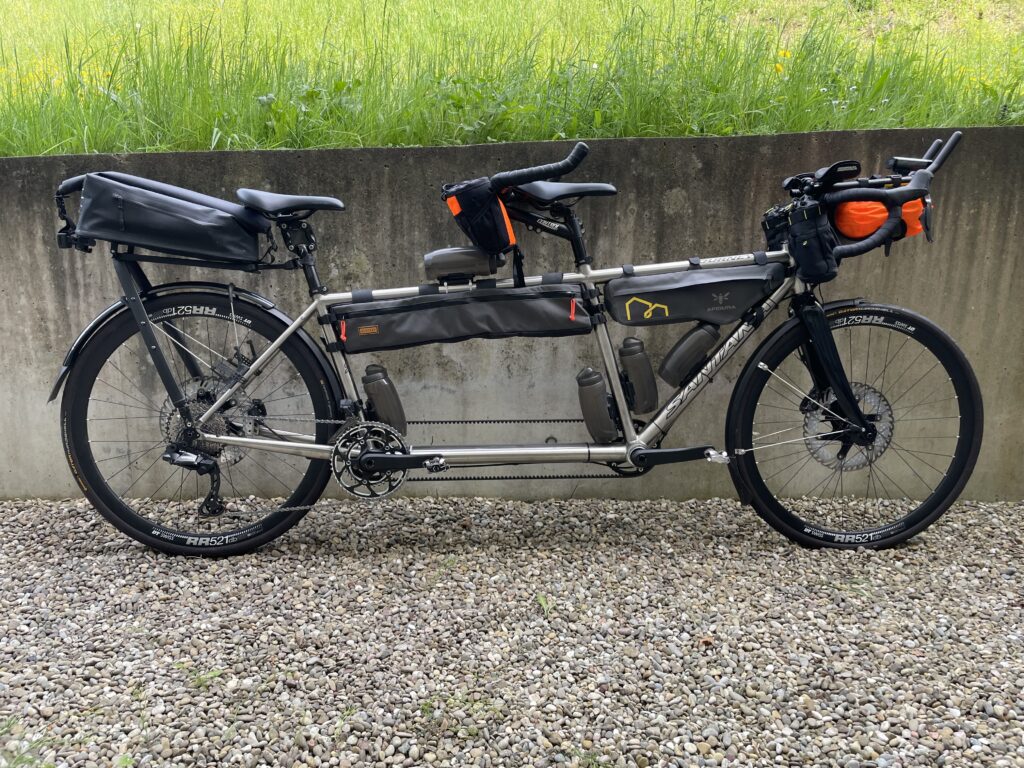
Our tandem is the Santana Journey. We bought it at Tandem Schweiz in Wolhusen, Switzerland, where we live.
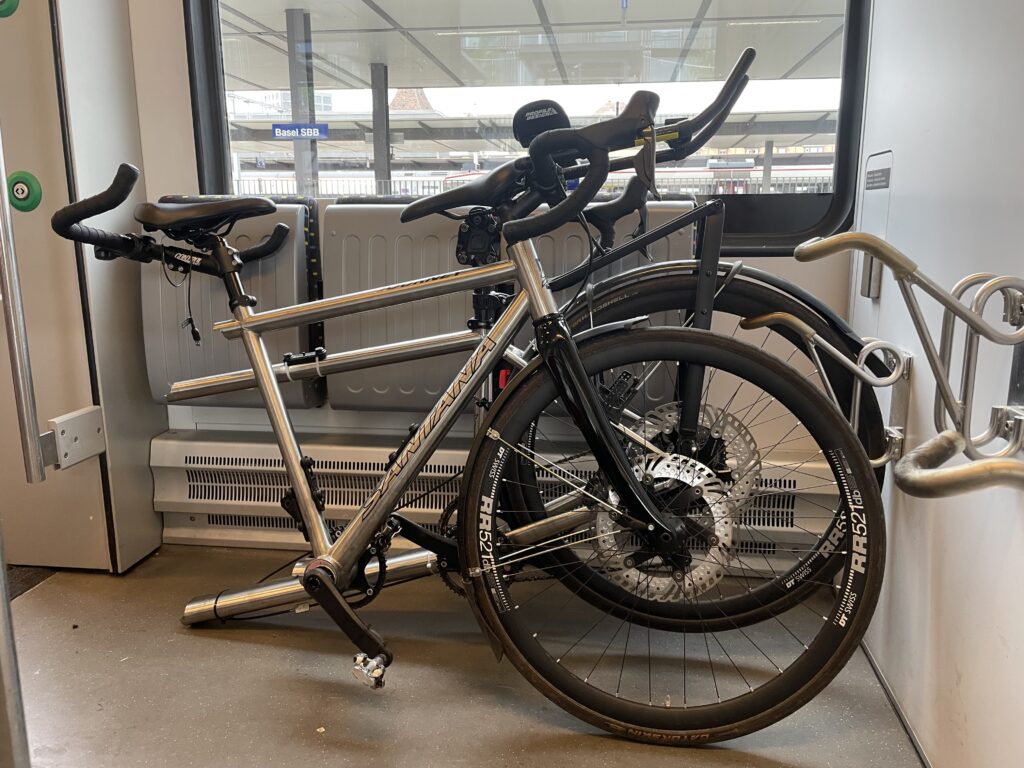
It features a hand welded titanium frame with Z-couplers. These are essentially engineered separation points in the frame that allow the bike to be taken apart into several pieces for easier transport. I added a picture of us transporting the tandem in a train.
The frame itself weighs 3.86 kg (8.51 lb). The complete tandem, including wheels, handlebars, drivetrain and all components, weighs 14 kg (30.86 lb).
Our tandem has an Ultra Di2 2×12 drivetrain. The chainring is tandem custom made and offers 34/50 teeth, and the cassette has 11/40 teeth.
The tandem is equipped with disc brakes at the front and the back. The wheels are from DT Swiss (RR521 db disc), and we run 32 mm tires.
The seat position for the rider at the back uses a Cane Creek Thudbuster LT suspension seatpost, for reasons explained below. We both ride with SPD pedals.
So how do you actually ride it?
Getting on
There are multiple ways to mount a tandem, but we generally prefer the following method:
- Marco stands on the left side of the tandem at the front, and I also stand on the left side but behind him.
- He swings his leg over the handlebars and straddles the bike. If he were to swing his leg over the saddle, as many riders do, he would kick me because I am standing right behind him.
- He then straddles the tandem between his legs, sits down on the top tube, and presses both brakes. He spreads his legs slightly so that when I turn the pedals, I do not hit him in the shins.
- Then the first part of clean communication begins. I need to know that he is holding the bicycle securely so I can get on safely. I ask: “Ready?” When he is set, he replies: “Yes, ready.”
- I confirm this by saying “Mounting.”
- I then mount the tandem much like I would mount an indoor trainer. I swing my leg over the saddle, clip in, and move the right pedal to roughly the 3 o’clock position. Then I say “I’m in, go.”
- Marco clips in his right foot, does a short countdown, stands on the right pedal, clips in his left foot as it comes up, and off we go.
Getting off
Getting off is almost exactly the reverse of getting on.
- Marco brakes, unclips his left foot, sits down on the top tube, presses both brakes, and says “Ready.”
- I reply “Getting off,” then clip out and dismount the bike the same way I would dismount from an indoor trainer.
Small stops
During short stops, such as traffic lights, I usually do not dismount the tandem.
Marco simply clips out his left foot and sits on the top tube while holding the brakes. Meanwhile, I move the right pedal back to the 3 o’clock position. When the light turns green, he does a short countdown and we start again.
There are two reasons for this. First, it saves time if I stay on the bike. Second, remaining clipped in means I can immediately provide power when we start moving. Because of its length and increased weight, a tandem can feel a bit wobbly at very low speeds. Having power available right from the start makes the launch much smoother.
What are the differences compared to a solo bike?
Plenty. I will list the main ones here.
Teamwork and communication
Riding one bicycle together requires solid communication and teamwork. Even when you are tired, bonking, soaked from the rain, and in a low mood where you are quietly hating the world and questioning all your life decisions. Always. Especially then. A few examples:
- Cadence: Marco’s drivetrain is connected to mine via a long belt called the timing chain. This means our pedals are locked in sync and we always share the same cadence. That includes when we are cycling up a hill and when one of us is tired and starts grinding the large chainring. Two people, one bicycle, one cadence.
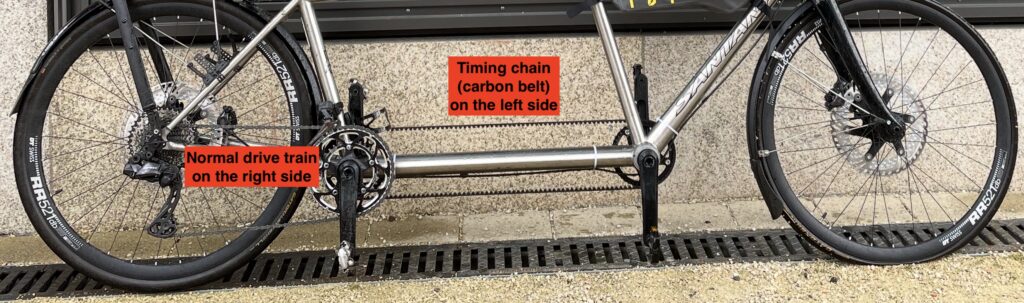
- Shifting gears: Marco has to announce when he shifts on the large chainring. If he does not warn me, I will not know, I will keep putting out power, and the chain will drop. That is inconvenient on a flat section of road, but if it happens while pushing up a hill it can easily cause us to topple over. He calls this out by saying “Shifting large front” or sometimes just “Shifting“, I then look down and say “Sits” when we successfully shifted so he knows he can start pushing again.
- Movement: Because a tandem is bigger and heavier, steering takes more strength, and any movement such as grabbing a water bottle, adjusting clothing, scratching your ear, or doing a victory dance has to be communicated. Even small shifts in weight can destabilize the whole operation. We literally cannot take a turn if I decide to lean in the wrong direction.
- Since I cannot see what is coming up next on the road, I often have to ask whether it is a good moment for me to do something, like grabbing a water bottle. Most of the time the answer is yes. Sometimes the answer is no, and you simply have to be content with waiting a bit before you can scratch that itch.
- It once happened that I was riding without holding the handlebars to take a picture. Marco suddenly had to brake, and I almost smashed face first into his back. After that we agreed that if I ever take my hands off the bars, I have to say so beforehand. That way he knows and can tell me whether we are in a suitable spot for it.
Trust (why not everyone is suited to be a stoker)
My handlebars do absolutely nothing except give me a place to rest my hands. I cannot steer, cannot brake, cannot shift, and I cannot see within about a 30 degree angle in front of me. It is a bit like riding a bicycle with your eyes closed while someone else steers, brakes, and shifts for you. It requires an immense amount of trust. I do not want to sound overly dramatic, but your life is literally in the hands of the other person. If they mess up, you crash. There is nothing you can do about it.
Because I cannot see what is happening up front, Marco always calls out when we are about to enter a tight squeeze, for example between two cars or between anti-vehicle bollards on the cycle path. This is very important, because when a car door suddenly appears about 10 cm next to me, I can get startled. That has happened before. When it does, my weight shifts, and we risk crashing into the very object we were trying to avoid.
The limited view also means that things sometimes happen without warning. Marco might brake suddenly and I have no idea why, until a frightened cat darts away a couple of seconds later. Or the tandem suddenly rocks to the side and I later realize he was avoiding a pothole.
Part of being a stoker means letting go of control. Sometimes things happen and you simply go with the flow. You cannot be a control freak at the back and get angry about every small thing. This is why I am convinced that not everyone is suited to being a stoker, but not everyone is suited to being a captain either. More on the latter below.
Strength & responsibility (why not everyone is suited to be a captain)
Because of its increased length and weight, a tandem requires more strength to steer. The rider in the front therefore needs to have the most upper body strength. This becomes especially noticeable in situations with strong headwinds or crosswinds, or when riding on gravel. I hate gravel, and on a tandem I hate it even more.
In addition, the captain is responsible for the safety of the stoker. On a solo bike, if you forget to unclip and topple over, if you are tired and make a wrong turn only to end up in a ditch, or if you miss a rock and crash, the consequences of those mistakes mostly fall on you.
On a tandem, there is a living, breathing human being sitting behind you who has no control whatsoever over their destiny and shares the same fate as you, for better or for worse. Their wellbeing is literally in your hands.
As I mentioned earlier, not everyone is suited to being a stoker. But because of the physical strength required and the weight of the responsibility, not everyone is suited to being a captain either.
Mechanical complexity
A solo bicycle has one drivetrain and the torque on the system is relatively stable. A tandem has two drivetrains. This not only means there is roughly twice the power and torque going through the system, but also that torque directions change more frequently.
The left side of my drivetrain is connected to Marco’s drivetrain, while the right side of my drivetrain is connected to the rear wheel. This means there are some seriously large forces pulling on both the left and right sides of my drivetrain. Add to that the fact that we ride ridiculous distances, and I suspect this is why we destroyed two bottom brackets early on.
Bag management
You are on one bicycle, sharing the same bags. This means you have to decide together what goes where. This requires a very clear definition of who carries what and where everything lives, otherwise finding something mid ride becomes an archaeological excavation.
Pedals
I rode about 25,000 km (15,534 miles) on my trusty $10 flat pedals. On a tandem, however, I discovered that this is a bad idea.
First, our drivetrains are linked through the timing belt and we share the same cadence. Sudden shifts in cadence or power from Marco would sometimes make me slip off the pedal or lose it altogether.
Second, even though he does his absolute best, Marco cannot see/avoid every single pothole on the road. Sometimes we hit one of those tree roots that push up the asphalt. When that happens, I occasionally get launched into the air a little. This once caused me to lose both pedals and then land back on the saddle. Dear reader, that hurts.
With clipless pedals I no longer lose the pedals, and mid ride launches have thankfully become a thing of the past.
Suspension seat post
On a solo bike you have far more freedom to move around. You can lie down in your aero bars and shift your weight slightly left and right. You can also see what is coming up ahead when a rough section of road appears.
On a tandem, my position is much more static. I stand up far less, I do not have aero bars, and weight shifts have to be communicated beforehand. Add to this that I cannot see rough patches of road coming up, and you can imagine that after a full day of riding, your behind risks resembling the texture of pulled pork.
This is why most stokers use a suspension seat post. I can confirm that it works. It absorbs micro vibrations and causes much less fatigue at the end of the day.
Trivia (a few smaller things)
Since I sit directly behind Marco, some things simply do not happen anymore.
- With two wheels instead of four, we even have slightly less rolling resistance
- When we ride through a swarm of bugs, I do not get any on me or on my face. The era of non-consensual entomophagy is officially over 🎉
- I sit directly in Marco’s draft, so there is less wind hitting me from the front. This has resulted in me being able to wear fewer layers because I am actually warmer on the bike. In winter this is quite nice. We will see how this plays out in summer.
- Again, since Marco acts like a windscreen, I do not get hit by rain as badly.
- I am always drafting perfectly, effectively giving us the wind resistance of 1 rider. This makes us more aerodynamic than we ever were when riding separate bikes. 🚲
Conclusion
On a tandem, you are essentially one being. You start together, pedal together, stop together, and move like a vaguely coordinated two person organism.
Yes, tandems demand more effort, communication, and coordination. But the benefits were exactly what we were looking for. Two riders, one bike, one combined power output. We can both cruise at around 80% FTP without anyone (read: me 🤣) getting dropped. We share the same climbs, the same rhythm, and the same exhaustion. No more Sena helmets disconnecting in defeat, and no more lonely summits.
To end this post, I will leave you with a few tandem riding survival rules.
- Communication beats power. One strong rider with poor communication skills leads to chaos and will cause the team to fail. A coordinated pair wins.
- Develop clear, non ambiguous language. Examples: Coast. Bump. Shift. Go. Stop.
- As a stoker, you simply have to let go of control. This requires immense trust, which can only be built over time.
- The bike is a shared organism. Both riders are responsible for the wellbeing of the other. 🚲